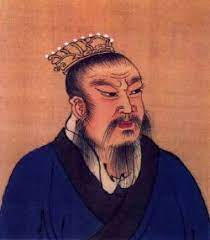
The social structure of the Han Dynasty was vast and complicated, even among the top. Obviously, the emperor was the absolute top. He was considered to be between heaven and earth as he had the Mandate of Heaven. There was a huge separation between him and everyone else, shown through the palace he lived in, hidden from everyone else. Many people in the palace simply had the job of tending to him in many ways, whether that be protection or making his food.
But the emperor and his close officials were only one part of the government. There were other bits throughout the empire which helped to keep government influence when the empire expanded.
The central government with the emperor was where much of the big stuff took place, but while the emperor’s influence was large, only a few people actually talked with the emperor. There were two statesmen that regularly talked with the emperor. Everyone else was split into nine offices, all supervised by other officials. The nine offices were on religion, observation of the stars, record keeping, security, caring for the stables, taking care of crimes, economic work, foreign communication, and more. The military had the same rank as those who ran the nine offices.
The side governments were split between commanderies and kingdoms. The number of commanderies and kingdoms fluctuated throughout the years of the Han dynasty, but they were always scattered throughout the empire and controlled closely by the central government. Commanderies were controlled by Grand Administrators, appointed by the central government, and kingdoms had kings that were related to the emperor in some way.
Even the commanderies and kingdoms were split into prefectures which were split into districts which were split into wards. The central government still had some level of control of each section, but small areas like wards could have more local leaders. There was still some government delegation to the wards, however. They still worked with the law of the central government.
Lawbreaking was not unusual early in the Han dynasty, even among officials. There are many cases of corrupt officials needing to be punished. Misusing government property was common, but it may not be surprising to hear that there was also an issue with bribery and abuse of power. To counter, the government had incredibly harsh punishments which included the death sentence which was not used sparingly.
Over time, corruption slowed down, likely because recruitment for official service became more merit based with the government asking for officials to recommend capable and virtuous people. The recommended men then had to go through an examination process an a sort of internship period before actually becoming an official. It wasn’t perfect, but it certainly helped.
WORK CITED:
Loewe, Michael, and Eva Wilson. Everyday Life in Early Imperial China during the Han Period 202 B.c.-A.d. 220. Batsford, 1968.
Wallace, Leslie V. Behaving Badly in Early and Medieval China. Edited by N. Harry Rothschild, University of Hawaiʻi Press, 2017. INSERT-MISSING-DATABASE-NAME, INSERT-MISSING-URL. Accessed 14 Oct. 2022.
